
The long-term goal of my lab is to advance our understanding of the molecular mechanisms underlying neurogenetic disorders caused by repetitive DNA sequences and RNA misprocessing, such as autism spectrum disorder and myotonic dystrophy.
Myotonic dystrophy (DM)
DM is the most common form of muscular dystrophy in adults, affecting 1 in 2,100 individuals worldwide (150,000 patients in the US alone). It progressively affects multiple systems, leading to disability and often premature death. There are no approved treatments for DM, and the average healthcare costs are 3.7 times higher in this population than the US average.
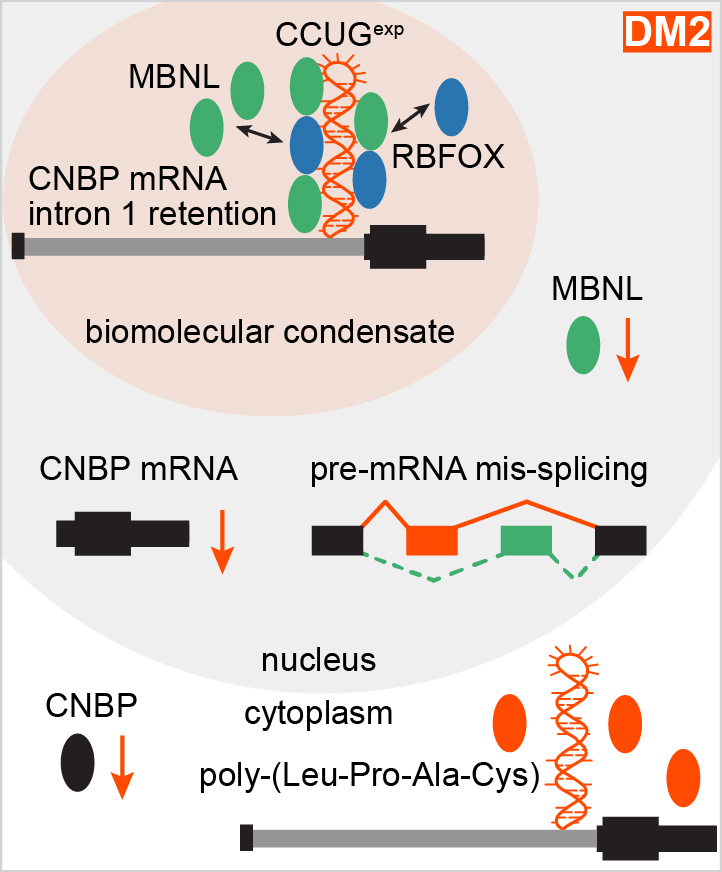
There are two types of DM disease, and both are autosomal dominant. DM type 1 (DM1) is caused by a CTG repeat expansion in the 3’ untranslated region of the DMPK gene, whereas DM type 2 (DM2) is caused by a CCTG repeat expansion in CNBP intron 1.
Compared to DM1, DM2 has received considerably less attention from academic researchers and biotech/pharma, since it is less prevalent, and no mouse models are available to test mechanisms and potential therapeutics. There are no clinical trials for DM2, and there is considerable uncertainty whether therapeutic strategies for DM1 would be effective for DM2, due to the lack of information on the disease mechanisms.
Therefore, it is important to develop therapeutic approaches that are tailored to the DM2 molecular mechanism.
Current evidence indicates that DM2 mainly results from the toxicity caused by the expanded CCUG RNA repeats gain-of-function mechanism that results in MBNL splicing factor sequestration on expanded RNA, and subsequent massive pre-mRNA mis-splicing. Although muscleblind-like splicing regulator (MBNL) sequestration on expanded repeat RNAs is a common molecular feature in both types of DM, the RNA gain-of-function mechanism in DM2 appears to be more complex due to at least three unique features. In DM2 expanded CCUG repeats are located in the intron, they can be exceptionally large (up to 44,000 additional CCUG base pairs), and recently identified RBFOX proteins compete for CCUG RNA binding with MBNL proteins.
Thus, a critical barrier to progress in the field is the lack of sufficient understanding of the mechanism by which expanded CCTG induces DM2, which should reveal therapeutic strategies to target this disease.
Autism spectrum disorder (ASD)
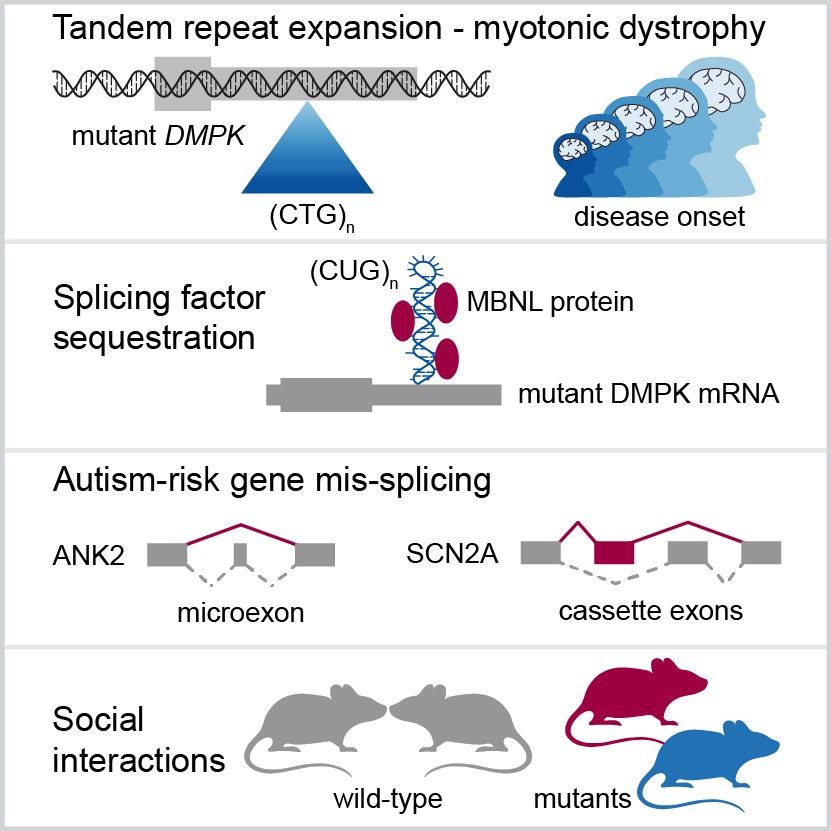
ASD is a set of neurodevelopmental conditions that affect communication and social interactions with restricted interests and repetitive behaviors.
Although ASD has one of the highest heritability rates of all complex disorders, and hundreds of genes are known to confer a risk for this neurodevelopmental condition, most of the ASD cases remain idiopathic. Therefore, a critical barrier to progress in the field is to identify additional ASD-risk genes.
Since most of the known ASD variants are biased toward coding regions, an unmet need is to evaluate the contribution of noncoding sequences in ASD etiology, including tandem repeats that account for ~5% of the human genome.
Recently two independent large-scale genome studies uncovered previously undetected and predominantly noncoding tandem repeat mutations that have been suggested to account for ~4% of idiopathic ASD cases. Although these studies opened uncharted territory by revealing numerous tandem repeat expansions in ASD, their contribution to the etiology remains uncertain.
Our objective is to test whether and how noncoding expanded tandem repeats contribute to the ASD etiology by inducing pathogenic gene regulatory mechanisms.
